Stamp duty on a buy to let in 2026 is standard SDLT plus a 5% surcharge on every band, so a £250,000 purchase now costs £15,000, double the £7,500 it cost between September 2022 and October 2024.
In short
- A buy to let pays standard SDLT plus a 5% surcharge on every band.
- Non-UK residents pay another 2% on top, across all bands.
- Companies pay the surcharge too, even on their first purchase.
- Six or more dwellings bought in a single transaction are still treated as non-residential property.
- On an investment purchase the surcharge is not refundable.
In this guide: 10 sections
- The two changes that stacked up
- Stamp duty rates on buy to let in 2026
- 2026 against 2022, side by side
- The hit to cash-on-cash return
- Company purchases and the SDLT bill
- The end of multiple dwellings relief
- Mixed-use and non-residential rates
- When the surcharge can be refunded
- Why SDLT changes the deal maths
- How to factor SDLT into a deal
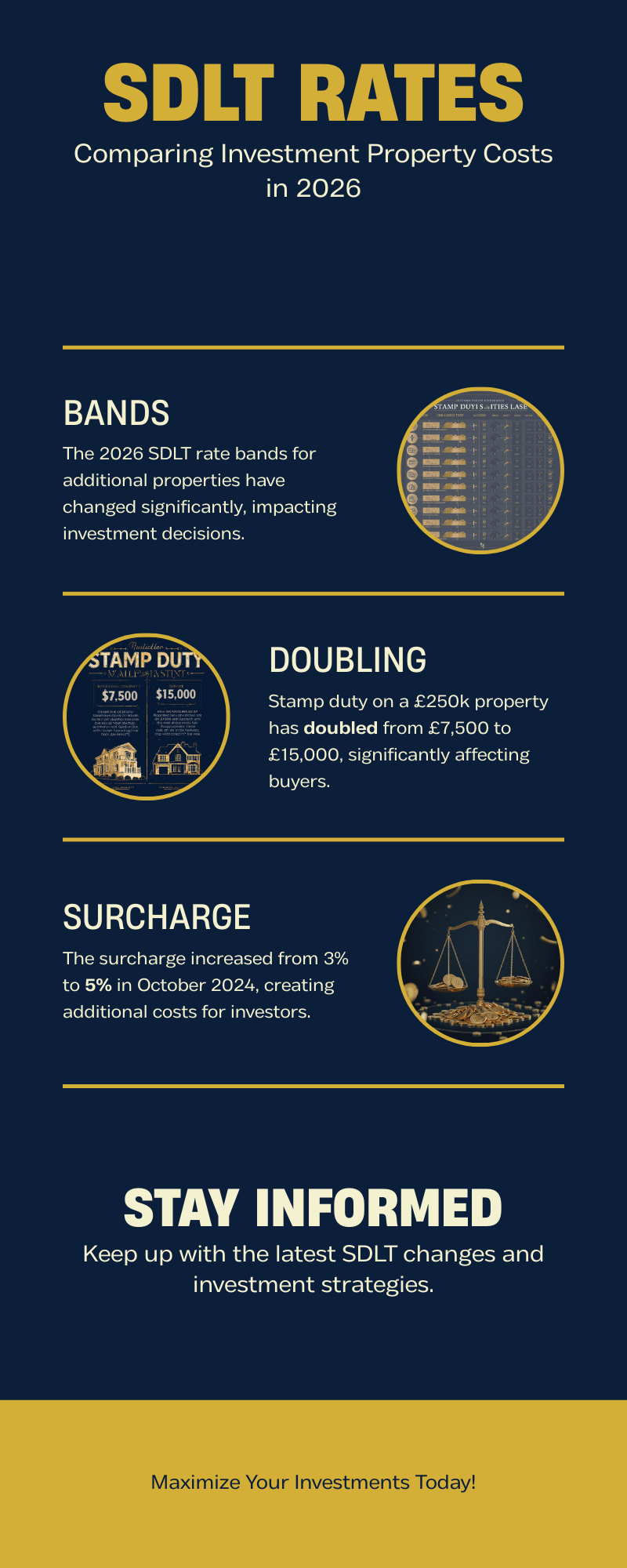
Two things have happened that changed the cost of buying an investment property in England. First, the additional property SDLT surcharge jumped from 3% to 5% in October 2024. Then, in April 2025, the nil-rate threshold dropped from £250,000 back to £125,000.
Together, those two changes mean that on a typical £250,000 buy-to-let your stamp duty bill has exactly doubled, from £7,500 to £15,000. And that’s before we talk about company purchases, non-UK resident surcharges, or what happened to Multiple Dwellings Relief.
This guide breaks down exactly what you’ll pay in 2026, how it compares to what you would have paid between September 2022 and October 2024, and how to factor it into your deal analysis so you stop underestimating your total acquisition cost. Whether you’re looking at a single off-market investment property or building a portfolio, getting this number right comes first.
The two changes that stacked up
There wasn’t one change. There were two, stacked on top of each other, and the timing means many investors missed one or both.
31 October 2024: Surcharge increase
The Autumn Budget 2024 increased the additional property SDLT surcharge from 3% to 5%. This applies to any completion on or after 31 October 2024 on second homes, holiday lets, and buy-to-let properties.
That’s a 67% increase in the surcharge rate, applied to the entire purchase price.
1 April 2025: Threshold reversion
The nil-rate SDLT threshold for standard buyers reverted from £250,000 back to £125,000. This was the end of the temporary increase introduced in the September 2022 mini-budget.
For additional property purchases, this means you now start paying SDLT, including the 5% surcharge, from a much lower starting point. Together, they mean a higher surcharge rate, applied from a lower threshold, across every band.
Stamp duty rates on buy to let in 2026
Here are the current rates for anyone buying an additional residential property for £40,000 or more in England or Northern Ireland, as confirmed on HMRC’s official SDLT rates page:
| Property price band | Standard rate | Additional property rate (standard plus 5%) |
|---|---|---|
| £0 to £125,000 | 0% | 5% |
| £125,001 to £250,000 | 2% | 7% |
| £250,001 to £925,000 | 5% | 10% |
| £925,001 to £1,500,000 | 10% | 15% |
| Over £1,500,000 | 12% | 17% |
SDLT is progressive, like income tax. You pay each rate only on the slice of the purchase price that falls within that band, not on the whole amount.
Non-UK residents: add another 2% on top of the rates above across all bands. That means a non-resident buying an additional property faces a combined surcharge of 7%, pushing the effective rate on the first £125,000 to 7%, and the band between £250k and £925k to 12%.
2026 against 2022, side by side
This is the comparison that matters. If your last purchase completed between September 2022 and October 2024, here’s how much more you’d pay today on the exact same property.
| Purchase price | Sep 2022 to Oct 2024 | 2026 | Difference |
|---|---|---|---|
| £150,000 | £4,500 | £8,000 | +£3,500, 78% more |
| £200,000 | £6,000 | £11,500 | +£5,500, 92% more |
| £250,000 | £7,500 | £15,000 | +£7,500, exactly doubled |
| £300,000 | £11,500 | £20,000 | +£8,500, 74% more |
| £500,000 | £27,500 | £40,000 | +£12,500, 45% more |
| £750,000 | £47,500 | £65,000 | +£17,500, 37% more |
| £1,000,000 | £71,250 | £93,750 | +£22,500, 32% more |
Show the calculations
| Purchase price | Sep 2022 to Oct 2024 | 2026 |
|---|---|---|
| £150,000 | £150k × 3% | £125k × 5% + £25k × 7% |
| £200,000 | £200k × 3% | £125k × 5% + £75k × 7% |
| £250,000 | £250k × 3% | £125k × 5% + £125k × 7% |
| £300,000 | £250k × 3% + £50k × 8% | £125k × 5% + £125k × 7% + £50k × 10% |
| £500,000 | £250k × 3% + £250k × 8% | £125k × 5% + £125k × 7% + £250k × 10% |
| £750,000 | £250k × 3% + £500k × 8% | £125k × 5% + £125k × 7% + £500k × 10% |
| £1,000,000 | £250k × 3% + £675k × 8% + £75k × 13% | £125k × 5% + £125k × 7% + £675k × 10% + £75k × 15% |
At £250,000 your stamp duty has doubled. That’s £7,500 of additional cash you need to find before you collect a single month’s rent.
The percentage increase peaks at £250,000, where the bill doubles, and shrinks as the price rises above it. Investors buying between £150,000 and £250,000 face increases of 78% to 100%.
At the higher end, the increases are still large in absolute terms, at £22,500 on a £1m property, but represent a smaller percentage jump.
The hit to cash-on-cash return
Gross yield ignores stamp duty. Cash-on-cash return does not, because the SDLT is part of the cash you put in. Take a straightforward £250,000 buy-to-let generating £1,100 per month in rent, a 5.3% gross yield:
| Cash in | Sep 2022 to Oct 2024 | 2026 |
|---|---|---|
| Deposit at 25% | £62,500 | £62,500 |
| SDLT | £7,500 | £15,000 |
| Legal, survey and broker fees | £3,000 | £3,000 |
| Total cash in | £73,000 | £80,500 |
That’s £7,500 more cash required before you’ve collected a penny in rent. Whatever cash the property returns each year is now measured against £80,500 instead of £73,000, so the same return is worth about 9% less as a percentage of the money you put in.
Acquisition costs: a spreadsheet still using the stamp duty of September 2022 to October 2024 overstates the return.
Company purchases and the SDLT bill
A common question, especially given the Section 24 mortgage interest restriction that makes personal ownership less tax-efficient for higher-rate taxpayers.
- For standard buy-to-let SPV purchases, the SDLT position is the same as buying personally: you pay the 5% additional property surcharge on top of standard rates.
- Companies always pay the surcharge, even on their first property purchase, because the company itself is treated as purchasing an additional dwelling.
- Where the cost escalates sharply is for corporate acquisitions of residential property above £500,000 by what HMRC calls “non-natural persons”, meaning companies, collective investment schemes and partnerships with corporate members. These can attract a flat 17% rate on the entire purchase price, increased from 15% in October 2024.
- However, most genuine BTL SPVs that are letting the property can claim relief from this flat rate and instead pay the standard additional property rates.
Buying through a company doesn’t cost more in SDLT for a typical BTL, but it doesn’t save you anything either. The case for an SPV structure rests on income tax efficiency, not on stamp duty savings.
Corporation tax is currently 19% on profits up to £50,000, rising to a main rate of 25% on profits above £250,000 with marginal relief between the two. A company gets relief for its mortgage interest through corporation tax rather than the Section 24 restriction, subject to a separate interest cap that only bites above £2 million a year for a group.
Personal rates on rental profit go up to 45% now and 47% from April 2027 in England and Northern Ireland. Scottish taxpayers pay Scottish rates on this income.
The end of multiple dwellings relief
If you’re looking at portfolio deals, multi-unit freehold blocks, HMO portfolios, or bulk purchases, you need to know that Multiple Dwellings Relief (MDR) was abolished on 1 June 2024.
MDR used to allow buyers of two or more dwellings in a single transaction to calculate SDLT based on the average price per dwelling rather than the total consideration. This could save tens of thousands on portfolio purchases.
The averaging mechanism is gone, and contracts exchanged on or before 6 March 2024 keep their MDR eligibility under transitional rules, but that is a narrow edge case at this distance.
What survives: six or more dwellings
What survives matters more on larger deals: section 116(7) of the Finance Act 2003 still automatically treats six or more dwellings bought in a single transaction as non-residential property, which moves the whole purchase onto the 0%, 2% and 5% table below with no additional property surcharge at all.
Six flats at £1.2 million, treated as non-residential
£49,500
The same deal at residential rates with the surcharge
£123,750
- For two to five dwellings there is no averaging and no non-residential treatment, so the full residential tables with the surcharge apply.
- Eligibility for the six dwelling treatment turns on the purchase genuinely being a single transaction, so take specific advice before pricing it in.
Either way the SDLT cost must be modelled accurately from day one, and it changes where your strike price needs to land to hit your target returns.
Mixed-use and non-residential rates
Non-residential and mixed-use property is charged on a different table:
| Property price band | Non-residential rate |
|---|---|
| £0 to £150,000 | 0% |
| £150,001 to £250,000 | 2% |
| Over £250,000 | 5% |
No additional property surcharge. No 5% on top. The maximum rate is 5%, compared to up to 17% for residential.
This is why commercial-to-residential conversions under Permitted Development Class MA, and mixed-use properties such as shops with flats above, have become increasingly attractive. If the property genuinely qualifies as non-residential or mixed-use at the point of purchase, the SDLT savings can be substantial.
£500,000 mixed-use property
£14,500
The same property as residential, with the 5% surcharge
£40,000
That’s a £25,500 difference, enough to fund a significant refurbishment.
If you’re exploring development opportunities or commercial conversion plays, get specific SDLT advice before exchanging. The classification at the point of completion determines the tax treatment, and HMRC do challenge claims of mixed-use status.
When the surcharge can be refunded
Replacing your main residence
If you’re buying a new main home and you pay the 5% surcharge because you haven’t yet sold your previous residence, you can claim a refund of the surcharge.
- You have three years from completing the new purchase to sell your previous main residence.
- Once it is sold, the claim must reach HMRC within 12 months of that sale, or within 12 months of the filing date of the SDLT return on the new purchase, whichever is later.
The three years is the deadline to sell, not the deadline to claim.
Investment purchases are different
No refund is available. The 5% surcharge on buy-to-let and second home purchases is permanent and non-refundable. It’s a sunk cost that must be factored into every acquisition.
Why SDLT changes the deal maths
SDLT doesn’t exist in isolation. It lands on top of an already shifting cost base for property investors in England:
- The Renters’ Rights Act took effect on 1 May 2026, abolishing Section 21 no-fault evictions. All tenancies are now periodic agreements. Landlords who want vacant possession will need to use Section 8 grounds, a slower and less certain process, although selling with the tenant in place needs no ground. This makes acquisition decisions even more consequential, because recovering possession from a bad deal just became harder.
- Making Tax Digital has been mandatory since April 2026 for landlords whose qualifying income from property and self-employment was above £50,000 in the 2024 to 2025 tax year, adding administrative cost.
- The EPC Band C by 2030 target, which government confirmed in its 21 January 2026 response it intends to apply from 1 October 2030 with a £10,000 cost cap per property, carries an estimated average spend of £5,400 per property in the government’s own impact assessment.
Treat the EPC target differently from the two above: it is a stated policy commitment rather than settled law. Government must first take new enforcement powers by Act of Parliament, then lay a statutory instrument it is aiming to bring into force in 2027. Model for it, do not underwrite it as a legal certainty yet.
Add a much higher SDLT bill and there is less room for error on what you buy and what you pay. That is not a reason to stop investing. It is a reason to be more disciplined.
How to factor SDLT into a deal
Here’s a quick framework for making sure your numbers are accurate:
- Calculate your exact SDLT. Use HMRC’s SDLT calculator or the worked examples above. Don’t estimate. Don’t round down. Get the precise figure.
- Add it to your total cash invested. Your cash-on-cash return denominator should include: deposit + SDLT + legal fees + survey + broker fees + any immediate refurbishment. SDLT is now one of the largest line items in that stack for most investment purchases.
- Stress test the deal with the SDLT included. If the deal doesn’t hit your target return with accurate SDLT, don’t convince yourself it will work by tweaking the rent assumptions. Either negotiate the price down to compensate, or walk away.
- Consider the acquisition structure. Personal vs. SPV, residential vs. mixed-use, single purchase vs. portfolio, each has a different SDLT profile. Get advice from a tax specialist before committing, not after.
What this means for property investors
If your last buy-to-let completed between September 2022 and October 2024, the SDLT landscape has changed. At £250,000, your stamp duty has doubled. At £300,000, you’re paying £8,500 more than you would have two years ago. At £500,000, it’s an extra £12,500.
The fix is the same at every price: put the exact SDLT figure into the cash you put in, and set your offer from there. Where investors are finding deals this year is covered in our England Off-Market Property Report 2026. SDLT is one line in a bigger tax picture on any purchase or sale. If you are weighing up a sale, see our guide to capital gains tax on a rental sale. Income tax on rental profit is changing too: our guides to the 2027 landlord tax changes and Making Tax Digital for landlords cover what is already law and what is still to come. Buying or holding an HMO brings its own council tax question, covered in our guide to who pays council tax in an HMO.
Browse what is available now, request a free, no-obligation desktop valuation if you’re a vendor considering selling, or get in touch to tell us what you’re looking for. For more investor insights, explore our property investment blog.
This is general information, not advice on your situation, so take independent advice before acting. This article was published on 12 March 2026 and updated on 14 September 2026. It reflects SDLT rates and thresholds current as at the date of the last update. SDLT rules can change, so always verify the latest rates on GOV.UK or consult a qualified tax adviser before making acquisition decisions. BlackBook Investments does not provide tax advice.